

If you are a Sydney business owner thinking about running Google Ads, the first question is usually simple: how much should I spend?
The honest answer is this: there is no universal Google Ads budget that works for every business. A local plumber in Western Sydney, a migration consultant in Parramatta, an ecommerce store selling across Australia and a professional service firm in the Sydney CBD will not need the same budget, the same campaign structure or the same cost per lead target.
But there is a practical way to think about it.
For most Sydney businesses, Google Ads should not be viewed as a random marketing expense. It should be treated as a controlled customer acquisition system. The right budget depends on your industry, location, competition, average cost per click, conversion rate, landing page quality, sales process and the value of each new customer.
This guide breaks down how Google Ads costs work in Sydney, what affects your budget, and how much businesses should realistically spend if they want meaningful results.
How Google Ads Costs Work
Google Ads usually works on a pay-per-click model. That means you are charged when someone clicks your ad, not simply when your ad appears.
The amount you pay per click is called your cost per click, or CPC.
Your CPC can change depending on several factors, including:
- how competitive your industry is
- how many advertisers are bidding on the same keywords
- the quality and relevance of your ads
- the quality of your landing page
- the location you are targeting
- the time of day your ads run
- the device your audience is using
- your bidding strategy
- your campaign history and conversion data
This is why two businesses can both spend $3,000 per month on Google Ads and get very different outcomes.
One business might generate 80 leads at $37.50 per lead. Another might generate 15 leads at $200 per lead. The difference is not just the budget. It is the strategy behind the budget.
So, How Much Do Google Ads Cost in Sydney?
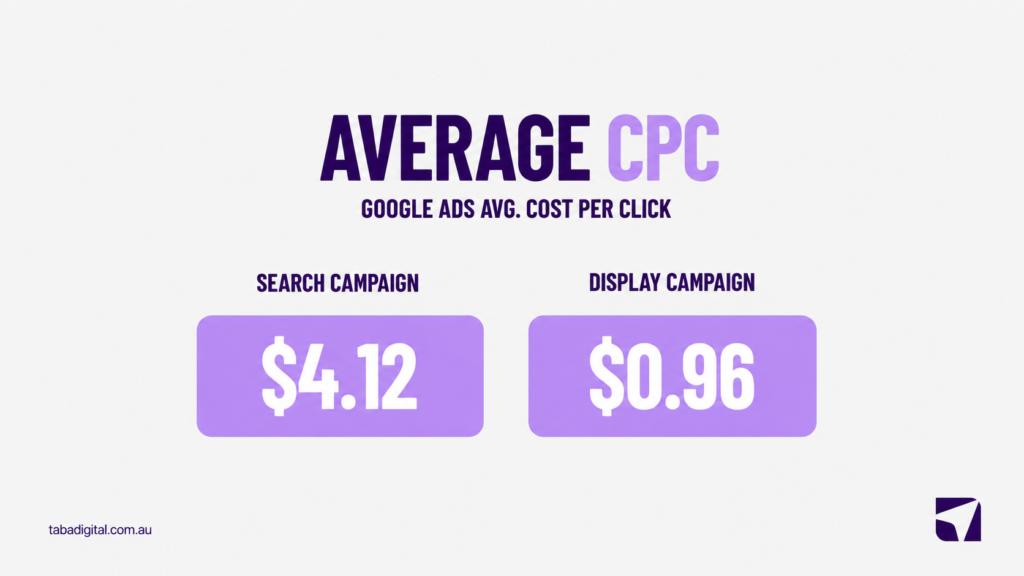
As a rough benchmark, many Australian businesses see search ad clicks sitting somewhere around the $2 to $4 range in less competitive categories. But that number can climb quickly in industries like legal services, finance, insurance, home improvement, medical services and emergency trade services.
In Sydney, competition is often stronger because more businesses are bidding for the same high-value customers.
A keyword like “buy candles online” will usually behave very differently from “emergency plumber Sydney”, “family lawyer Sydney” or “migration agent Sydney”. The intent is different, the customer value is different and the competition is different.
The better question is not:
How cheap can my clicks be?
The better question is:
How much can I afford to pay to acquire a profitable lead or customer?
That is where the real budget conversation starts.
Recommended Google Ads Budget Ranges for Sydney Businesses
Here is a practical guide.
| Monthly Ad Spend | Best For | What To Expect |
|---|---|---|
| $500 to $1,000 | Very small tests or low-competition niches | Limited data, slower learning and fewer optimisation signals |
| $1,500 to $3,000 | Small local businesses starting properly | Enough budget to test keywords, locations, ads and landing pages |
| $3,000 to $7,000 | Competitive local services and professional services | More reliable data, stronger testing and better optimisation potential |
| $7,000 to $15,000+ | High-value services, ecommerce and aggressive growth | More scale, broader testing and stronger market coverage |
For most Sydney small businesses, a realistic starting point is usually somewhere between $1,500 and $3,000 per month in ad spend, before management fees.
That does not mean every business must start there. But if your budget is too low, Google Ads becomes difficult to optimise because there is not enough data to make smart decisions.
A $10 per day campaign can technically run. The problem is that it may only generate a few clicks per day in competitive industries. If those clicks do not convert, it becomes hard to know whether the issue is the keyword, the ad, the landing page, the offer, the tracking or simply the lack of data.
Daily Budget vs Monthly Budget
Google Ads works with daily budgets, but most business owners think in monthly budgets.
A simple way to estimate your daily budget is:
Monthly budget divided by 30.4 = average daily budget
For example:
| Monthly Budget | Approx. Daily Budget |
|---|---|
| $1,500 | $49 per day |
| $3,000 | $99 per day |
| $5,000 | $164 per day |
| $10,000 | $329 per day |
This matters because a campaign with a $30 daily budget behaves very differently from a campaign with a $150 daily budget.
If your clicks cost $10 each and your budget is $30 per day, you may only get around 3 clicks per day. If your website converts at 5 percent, you might need around 20 clicks to generate one lead. That means you may only get a lead every several days.
That is not necessarily bad, but it changes expectations.
What Affects Google Ads Cost in Sydney?
1. Industry Competition
Some industries are simply more expensive because the customer value is higher.
A business that earns $5,000 from a new client can usually afford to bid more aggressively than a business that sells a $50 product. That is why professional services, finance, legal, medical and home services can become competitive in Google Ads.
The higher the value of the customer, the more businesses are usually willing to pay for the click.
2. Keyword Intent
Not all keywords are equal.
Someone searching “what is SEO” is researching.
Someone searching “Google Ads agency Sydney” may be comparing providers.
Someone searching “emergency electrician near me” is ready to act.
High-intent keywords usually cost more because they are closer to conversion.
A smart Google Ads campaign does not just chase traffic. It prioritises search terms that are more likely to produce commercial outcomes.
3. Location Targeting
Sydney is not one market. It is many micro-markets.
Targeting all of Sydney may cost more than targeting a defined service area like Parramatta, Inner West, North Sydney, Bankstown, Liverpool, Blacktown or the Northern Beaches.
For local businesses, tighter location targeting can reduce wasted spend. For service businesses that can operate across Greater Sydney, the right strategy may be to segment campaigns by area, service type or lead value.
4. Landing Page Quality
Your Google Ads budget does not work alone. The landing page has to convert.
If your landing page is slow, unclear, generic or hard to use on mobile, you will pay for clicks that do not turn into leads.
A strong landing page should make it clear:
- what you offer
- who you help
- where you operate
- why someone should trust you
- what action they should take next
- how to contact you quickly
This is where many campaigns fail. The ads may be decent, but the website does not turn visitors into enquiries.
5. Conversion Tracking
If conversion tracking is not set up properly, you are not really managing Google Ads. You are guessing.
At minimum, you should track:
- form submissions
- phone calls
- quote requests
- purchases
- booking actions
- important button clicks
- qualified lead actions where possible
Without tracking, you may know how many clicks you received, but not which clicks produced real business value.
Good tracking helps answer better questions:
- Which keywords generate leads?
- Which ads bring qualified enquiries?
- Which locations perform best?
- Which campaigns waste spend?
- What is the actual cost per conversion?
6. Campaign Structure
A messy campaign structure can waste budget quickly.
Common issues include:
- too many broad match keywords
- weak negative keyword lists
- one campaign trying to do too much
- no separation between services
- no location strategy
- poor ad group structure
- no conversion-based optimisation
- search terms not reviewed regularly
A good structure gives Google cleaner signals and gives the advertiser more control.
Is $500 Per Month Enough for Google Ads?
Usually, not for serious lead generation in Sydney.
A $500 monthly budget gives you around $16 per day. In some industries, that might only buy one or two clicks per day. That is not enough to test properly, especially if you are in a competitive market.
It may be enough for:
- a small brand protection campaign
- a very narrow local test
- a low-competition niche
- a remarketing campaign
- a temporary proof-of-concept
But for most Sydney service businesses, $500 per month is usually too limited to generate consistent results.
Is $1,500 to $3,000 Per Month Enough?
For many small businesses, yes, this is a more realistic starting range.
At this level, you can usually test:
- core keywords
- different ad messages
- one or two service categories
- selected Sydney locations
- landing page performance
- conversion tracking accuracy
- early search term quality
This budget is still not unlimited, so it must be focused. The mistake is trying to target every service, every suburb and every possible keyword from day one.
A better strategy is to start with the highest-intent services and locations, then expand once the campaign has data.
How Much Should Trades Spend on Google Ads in Sydney?
Trades and home service businesses often face strong competition because the leads can be urgent and valuable.
For trades such as electricians, plumbers, roofers, mechanics, builders, pest control businesses and repair services, a realistic starting budget is often between $2,000 and $5,000 per month, depending on the service area and competition.
Emergency services may need more because urgent keywords often attract higher CPCs.
The key is not just lead volume. It is lead quality.
A trade business does not need hundreds of junk enquiries. It needs calls and quote requests from people in the right location who need the right service and have genuine buying intent.
How Much Should Professional Services Spend?
Professional services can be expensive in Google Ads because the value of one client can be high.
This includes industries such as:
- migration services
- legal services
- finance
- accounting
- consulting
- medical and allied health
- coaching or advisory services
For these businesses, budgets often need to be higher because clicks can be more expensive and the buyer journey can be more considered.
A starting budget of $3,000 to $7,000 per month may be more realistic if the goal is to generate consistent qualified leads.
However, the campaign must be built carefully. Professional service leads are not all equal. One enquiry may be worth thousands of dollars, while another may be completely unsuitable. This is why lead qualification, landing page messaging and conversion tracking matter.
How Much Should Ecommerce Businesses Spend?
Ecommerce budgets depend heavily on product margins, average order value, repeat purchase rate and inventory.
A small ecommerce store might start with $2,000 to $5,000 per month, while a more aggressive growth campaign may require significantly more.
For ecommerce, the question is not only cost per click or cost per purchase. You also need to look at:
- return on ad spend
- profit margin
- customer acquisition cost
- average order value
- repeat purchase behaviour
- product feed quality
- shopping campaign structure
- Performance Max strategy
A campaign can show strong revenue but still be unprofitable if margins are low. This is why ecommerce Google Ads must be managed with commercial discipline, not just revenue screenshots.
Google Ads Management Fees
Your Google Ads budget is separate from management fees.
Ad spend goes directly to Google. Management fees go to the agency or specialist managing the campaign.
Management fees may be charged as:
- fixed monthly fee
- percentage of ad spend
- tiered package
- hybrid model
- setup fee plus monthly management
For small businesses, management fees can vary widely depending on the complexity of the account, number of campaigns, reporting requirements, tracking setup and strategic involvement.
The cheapest option is not always the best option. Poor management can waste more money than it saves.
A good Google Ads manager should help with:
- campaign strategy
- keyword research
- ad copy
- conversion tracking
- search term reviews
- negative keywords
- bidding strategy
- landing page recommendations
- budget control
- performance reporting
- ongoing optimisation
If someone is only “setting and forgetting” campaigns, that is not proper management.
How To Know If Your Google Ads Budget Is Working
Your budget is working if it is producing commercial progress.
That does not always mean instant profit in week one. But it should show signs that the campaign is moving in the right direction.
Look at:
- cost per lead
- lead quality
- conversion rate
- search term relevance
- cost per sale
- return on ad spend
- phone call quality
- landing page conversion rate
- revenue generated
- pipeline value
Clicks alone are not enough.
A campaign with 1,000 clicks and no qualified leads is not successful. A campaign with fewer clicks but better leads may be far more valuable.
The Biggest Budget Mistake Sydney Businesses Make
The biggest mistake is spreading the budget too thin.
Many businesses try to target:
- too many services
- too many locations
- too many keywords
- too many campaign types
- too many offers
This creates weak data and poor optimisation.
A better starting strategy is to focus on the service or product with the strongest commercial intent.
For example:
Instead of targeting every service you offer, start with the one that has the clearest buying intent, strongest margin and best chance of converting.
Once that works, expand.
So, How Much Should You Spend?
Here is the practical answer.
If you are a Sydney business testing Google Ads seriously, start with a budget that gives the campaign enough data to learn.
For many businesses, that means:
- $1,500 to $3,000 per month for a focused small business campaign
- $3,000 to $7,000 per month for competitive local services or professional services
- $7,000+ per month for aggressive growth, ecommerce or highly competitive industries
But the right number depends on your numbers.
Before setting a budget, ask:
- What is a lead worth to us?
- What is a customer worth?
- What is our close rate?
- What cost per lead can we afford?
- How many leads do we need per month?
- Is our landing page ready to convert?
- Is tracking properly set up?
- Are we prepared to optimise over time?
Google Ads can be a powerful growth channel, but only when budget, strategy, tracking and landing pages work together.
Final Takeaway
Google Ads in Sydney is not about spending the most. It is about spending with control.
A good campaign should help you understand what people are searching for, which keywords create opportunities, which ads generate action and which parts of your website convert visitors into customers.
If your budget is too low, the campaign may never collect enough useful data. If your budget is high but poorly managed, you can waste money quickly.
The best approach is to start with a realistic budget, focus on high-intent opportunities, track every meaningful conversion and optimise based on business outcomes, not vanity metrics.
If you want to understand what budget makes sense for your business, TABA Digital can review your goals, industry, service area and current marketing setup, then recommend a Google Ads strategy built around qualified leads, sales and measurable growth. Click here to submit a form.